
Every year, large amounts of leftovers from the food industry, so-called side streams, are either turned into low value products or discarded. A smart new sensor can help the industry make better use of these materials by monitoring and controlling the process that turns them into high value protein.
When food products are made from meat and fish, substantial by‑products remain, such as skin, bones, or shells. With novel biotechnological processes, materials that currently end up as low value products or waste can instead be turned into valuable compounds.
One such compound is protein. Many companies are trying to convert these leftovers into protein‑rich ingredients for use in animal feed, dietary supplements, and functional food products.
“Demand for protein is increasing globally. New technology can help the food industry become more sustainable, more efficient, and better prepared for the future,” says Bijay Kafle.
A smart sensor to assess protein quality
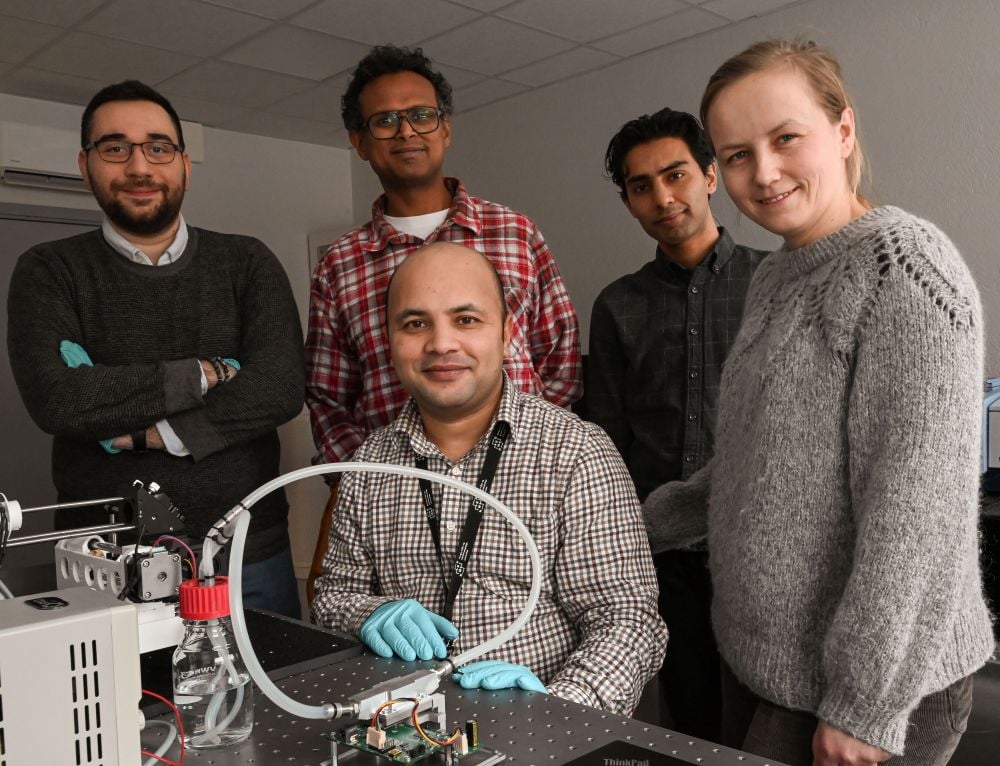
Kafle is a researcher at the Norwegian University of Life Sciences (NMBU). There, he works on the IR project, which is part of the DigiFoods centre. In this project, researchers are developing infrared sensor technology that can help industry monitor and control the quality of their food processes.
The food industry can use this technology to optimally extract high‑quality proteins from residual raw materials. These proteins are called protein hydrolysates. Hydrolysis industries currently use these hydrolysates mainly as animal feed. Now they are looking to produce them as a human grade protein ingredient as well. To succeed in that, the protein hydrolysates must be high-quality.
Extracting these proteins from the raw materials is challenging. One common method is enzymatic hydrolysis. The raw material, such as fish carcasses, is grounded and hydrolysed using enzymes that break proteins into smaller fragments. During hydrolysis, the protein composition changes continuously depending on the raw material composition and process parameters. As a result, the quality of the final product varies throughout the process.
In this process, precise control is essential. But today’s conventional quality‑assessment methods are time‑consuming, costly, and carried out in laboratories far from the production line.
“Current spectroscopic tools, such as commercial infrared spectrometers, are large, require manual sampling, and must be operated by trained personnel. They are also sensitive to heat, moisture, and dirt, which make them poorly suited for harsh industrial environments,” says Kafle.
Lab results take time, so production often continues unchanged while quality varies. “When protein quality changes rapidly throughout the hydrolysis process, it’s crucial that the sensor can track these changes and measure quality in real time,” says Kafle.
Research performed at Nofima shows that variation in raw materials, enzyme types and process parameters, such as temperature, water addition and flow rate, affect the composition of the protein hydrolysates.
While spectral data from offline infrared measurements can be linked to hydrolysate quality and differences in raw materials quality and enzyme types, these analyses are performed too late to support real-time process control. A fast, robust sensor capable of measuring protein composition inline, directly in industrial production lines, is therefore still missing.
Compact, lightweight and automated
The NMBU researchers hope to solve this problem using mid‑infrared light and advanced data modelling. In a spin-off project of the DigiFoods centre, the SmartSense4Protein project, the team is developing a compact sensor that can be installed directly in the production line and monitor protein hydrolysis continuously. It extracts small samples automatically, every minute during processing. The plan is to use the data in a digital twin which in the future will control the process to obtain a stable and high product quality.
“Inline measurement of protein hydrolysates directly from the process lines is challenging,” says Mehmet Can Erdem. He is a PhD student in DigiFoods, where he works with infrared sensor development and data analysis.
“The process is highly dynamic and samples are heterogeneous and difficult to measure consistently with conventional spectroscopic tools. This motivates new inline sensing techniques based on direct interaction between the light and the material,” he says.
Protein hydrolysates are complex mixtures of oil phase, water phase, and solid phase. The water phase is rich in peptides and amino acids, which are the most important for nutrition and quality. Sample preprocessing is necessary to separate these phases, which is done in a bypass loop. This water phase is therefore separated and sent to a flow-cell for analysis.
The sample flows through a flow cell – a small measurement cell through which liquid can pass – allowing analysis without stopping the process. Inside the flow cell, the sample is illuminated with mid‑infrared light, which provides detailed information about its chemical composition.
Data models interpret the infrared signals
By using advanced data models, the system can convert infrared signals into meaningful quality metrics, such as peptide levels, changes in molecular size, and collagen content. This provides a real‑time snapshot of how far the hydrolysis has progressed.
“This allows us to monitor and control the process with high precision, even when the raw materials vary”, he says.
When each measurement is completed, the system cleans itself automatically. This allows it to deliver continuous and stable measurements without manual intervention.
Technology for the food industry of the future
The smart infrared protein sensor is being developed specifically for use in industrial food production. The researchers work with DigiFoods partners Biomega and Bioco, who provide real industrial samples from their factories. These allow the team to tailor the setup to industry needs.
“The goal is to move from prototype to full industrial demonstration, ensuring the system is robust, reliable, and easy to integrate into existing production lines,” says Kafle.
The infrared device is also designed with future digital food production in mind. The system can feed real‑time data into digital models of the production process, enabling prediction of outcomes, performance optimisation, and improved traceability.
Kafle believes the technology could have a significant impact on the food industry. With better real‑time control, companies can make better use of raw materials, reduce waste, and turn by‑products into valuable ingredients for food and feed.
“This supports the broader vision of Industry 4.0, where extensive digitalisation connects factories, people, and products into intelligent and efficient systems,” he says.