
Ellen Altenborg sits on the board of DigiFoods and works as a scientist on why deep tech innovation succeeds – or fails. Her background from Telenor, the agricultural robot Thorvald and several startup environments has given her insight into what it takes to move scientific breakthroughs from the lab to the market.
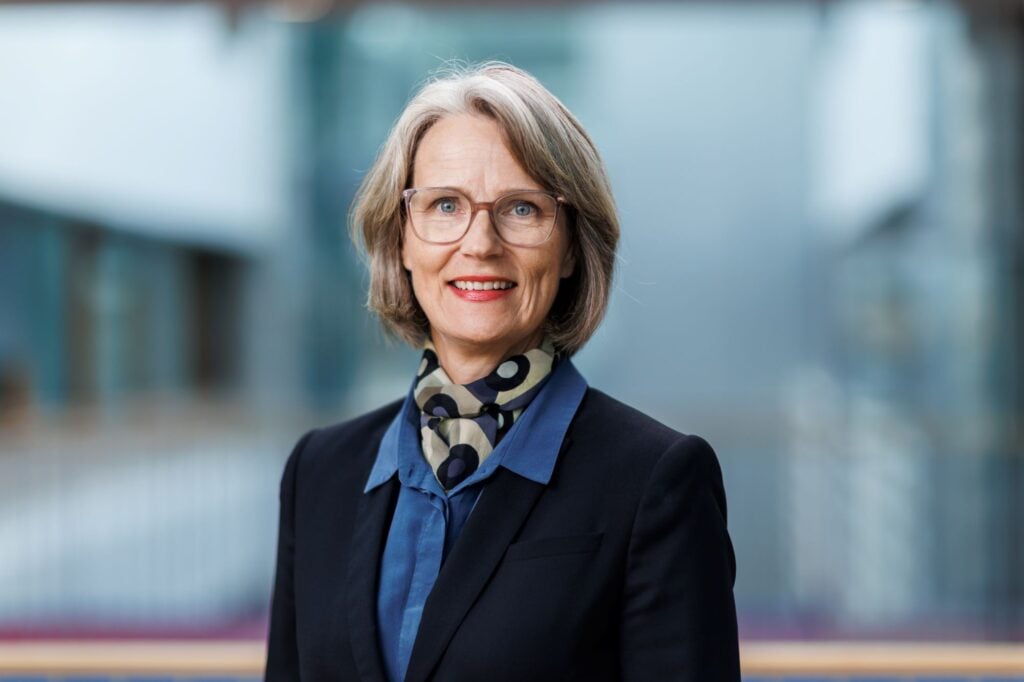
The original plan was to become an academic. In the 1990s, Ellen Altenborg completed a PhD in strategy at the Norwegian School of Economics with Telenor as topic. When Telenor then offered her a position in its newly established Group Strategy department, it was impossible to turn it down.
“This was just after Televerket became Telenor, when mobile phones and the internet were still new. The challenge was both cool and exciting. I told myself I would do this for a couple of years – and then go back to academia,” Ellen Altenborg recalls.
It would be another 25 years before she actually returned to academia – because she discovered how much she enjoyed business. Throughout her career she has worked in technology companies, always close to new technology and its commercialisation. At Telenor she worked with regulatory issues, stock exchange listings and mergers. In her last years there, she worked on new business areas, developing fintech solutions and new financial products.
“We actually built something very similar to Vipps long before DNB – but for Pakistan and other countries in South Asia,” she says.
Discovery of deep tech
By coincidence, Ellen Altenborg met Pål From, the scientist behind the agricultural robot Thorvald and Saga Robotics. That encounter drew her into the startup environment at NMBU and led her to deep tech, which she defines as technology so complex that it requires a strong academic background to really understand.
She quickly realised that many of the solutions to global challenges are developed at universities – but often remain there. Finding ways to bring deep tech out of academia and into use is what drives her, also in her current role as Associate Professor at BI Norwegian Business School. At the core of her research lies a simple but demanding question: What does it take for deep tech knowledge from universities and research environments to be turned into commercial solutions – and how can we make that journey faster?
“It is an extremely demanding process to take deep technology – the science itself – run it through a commercialisation process and actually get it out into the world. This is not something that just rolls forward by itself. The processes are long, and the need for funding along the way is substantial. Many ventures fail, and you rarely hear much about them – you mostly hear about the few that succeed,” Ellen explains.
Technology is not the same as a product
Her work with the Thorvald robot gave her a close-up view of how complex the journey from technology to product really is. Patience and a deep understanding of the technology are essential to grasp the real opportunities and limitations, and to estimate how long development will take. The technology must be stable and reliable before you can enter into commercial contracts. Getting it to that point takes both time and funding.
“Technology and product are not the same – the differences are actually quite substantial. Take Thorvald as an example: the technology can be used for many things and solve a range of tasks. But you must identify the first application area that is accessible and create enough value for someone to invest time and money. That’s what buys you the time you need to make the technology truly robust. The first product from Saga Robotics was area-based UV light treatment, offered as a service,” she says.
Commercial thinking has to come in early
One of the key differences between a research project and a company is how people relate to the future. Customers expect a company to be there as a long-term supplier, and partners behave differently towards a business than towards a time-limited research project. The level of commitment is deeper and of a different nature.
Ellen Altenborg is clear that commercial thinking needs to come in much earlier than is often the case today.
“I have spent countless hours out on farms with Thorvald, just watching how it actually works in real life. We need more people who both understand the technology and have commercial instinct – people who are willing to put on the crampons or the blue overalls and be out where things happen, not just sit in an office. It takes time, and it requires focused effort and relationships with people who can help pull the project forward,” she says.
Limited capital, strong cultural advantages
Bringing deep tech to market requires the ability to live with complexity across several disciplines – and it requires capital.
“Lack of capital is a real challenge in Norway, more so than in Sweden. But we also have some strong advantages. Norwegians are generally good at dealing with uncertainty and taking responsibility. Any development environment needs people who work independently and are willing to try things, and that is deeply rooted in Norwegian work culture. Things simply move faster when the boss is not controlling every detail,” Ellen Altenborg says.
She also points out that Norwegian scientific environments are highly applied and practice-oriented. In her view, this gives Norway a strong starting point – and it is easier to improve the capital situation than to change the underlying culture.
Building competence for the future
DigiFoods is the first centre for research-based innovation (SFI) in which Ellen has been heavily involved.
“The concept is very strong, and the long-term perspective is crucial. By narrowing the focus to the food industry, as DigiFoods has done, you remove a lot of complexity and enable companies to take concrete steps – change processes, adjust how they work and build new relationships. That strengthens the industry. What I appreciate most, though, is the competence building: the PhDs that remain as a foundation. In DigiFoods, that means people who really understand fisheries, aquaculture and the wider food industry – all major sectors in Norway,” she says.
She emphasizes that only the public sector can make such investments in long-term capacity building. The risk is simply too high for private capital, and the impact is difficult to measure in the short term.
Digifoods technology in the classroom
Ellen brings DigiFoods technology directly into her teaching. She uses the DigiFoods sensor concept SenseInside as a case for master’s students in strategy and entrepreneurship. The students are tasked with developing a financial model for the sensor while learning to handle complexity in both technology and market. This gives them hands-on experience in understanding technological constraints, quantifying uncertainty and evaluating different market opportunities.
“It was important to choose a case based on a technologically complex product that they were not already familiar with. They need to learn how to approach and manage that complexity. This kind of experiential learning gives an understanding you simply cannot convey on paper,” Ellen concludes.